
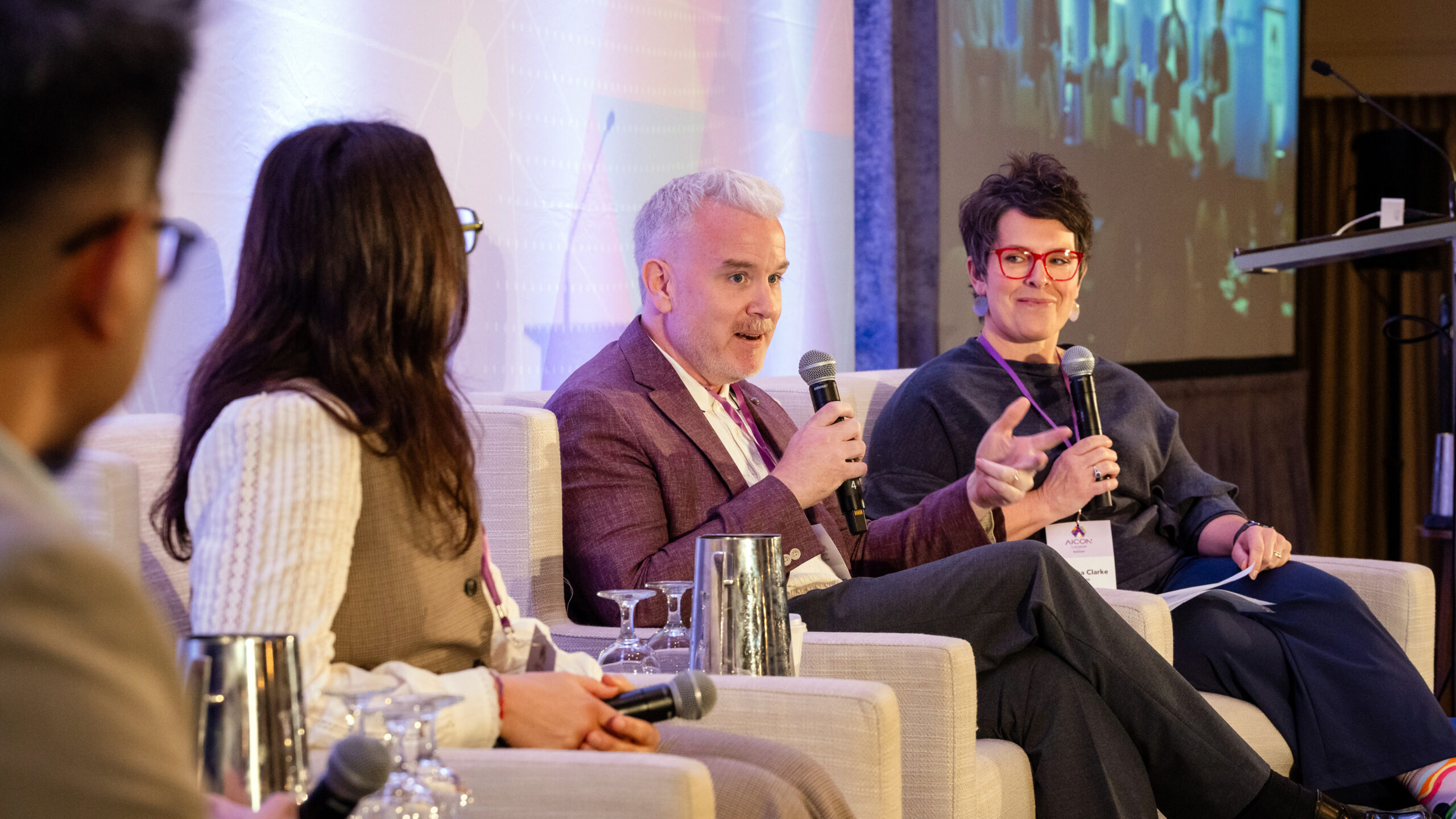
Mike Davis opened AICON Canada with a confession: he doesn’t really like conferences. Too much talk, not enough…doing. So we set out to curate something different—two days in Halifax built around action, not panels about action. That idea stuck. People kept circling back to it on stage and in the hallways: don’t just leave inspired, leave with something you’re actually going to do.
So, public sector leaders—here’s your to-do list. And the throughline is: yes, AI. But people first. Always.
1. Level Up and Bring Everyone With You
You can’t lead what you don’t understand, so build your own AI literacy and your team’s—at the same time. This isn’t a relay where leaders learn first and everyone else waits at the line; that only slows the whole thing down. Start now, learn out loud, and do it together.
Alberta’s AI Academy is free and genuinely good. And follow people doing this in the open like Hillary Hartley, Matt Cooper and Nate Glubish.
2. Problems Over Projects
Matt Cooper nailed this one: don’t go hunting for a place to use AI. Start where the pain already is.
This matters because roughly 80% of AI transformations aren’t moving results, and one stat in the room put enterprise AI failure at 95%. The fix isn’t fancier tech—it’s focusing on real problems that are worth solving. Identify the pain points you already have, hypothesize, and test. And, ask Matt’s four questions to help inform any initiative:
- Is it the right problem?
- Can we build it?
- Is it achieving the desired outcome?
- Can we effectively manage the change?
Test your riskiest assumption early and keep testing and learning with the goal to be less wrong over time.
3. Create the Conditions to Just Get Started
Readiness isn’t a strategy deck you finish before you begin—it’s a muscle you build by delivering. Matt’s recipe to get moving: pick a problem you’re already focused on, find the innovator closest to it, make them responsible, and sponsor the learning, not just the wins. Rob Newcombe reinforced this by giving us a roadmap for building a human-centred AI practice—one that starts by creating the right conditions including supportive organization design, psychological safety, and a culture that learns by doing.
Or, as I put it on the panel I moderated on the right ingredients:
Resist the urge to have everything figured out. Don’t let the what-about-ery get in the way of testing and learning.”
4. Be Sovereign by Building, not Just Writing About It
The theme of “Sovereignty as Strategy” was especially timely and relevant with the drop of the Government of Canada’s AI for All Strategy this week. And Sean Mullins and Jaxson Kahn’s recent research also mapped the real opportunities and risks for Canada—essential reading for decision-makers and suppliers alike.
And Andrew Forde (KPMG) gave me the line I can’t shake: “in Canada we still treat knowledge like an expense line. Visible infrastructure gets budgets; invisible infrastructure gets admired.” We pray for innovation instead of building the operating system that makes priorities like procurement reform, compute sovereignty, delivery authority, and national execution real. A country can’t be sovereign in AI if all it knows how to do is write papers about AI.
So, build procurement pathways that can buy learning because iteration with accountability is the point. And build capability institutions, not just programs.
5. Equity is Part of the Design Spec
The fastest way to lose public trust is to ship AI that works great for most people and quietly fails the ones already at the margins. Equity isn’t a box you bolt on at the end—it’s what tells you whether you built the right thing at all. People decide whether a promise is kept at the point of service. If it doesn’t serve everyone, it isn’t done.
Less Talk, More Action
That’s the do-list. I’ll add one last thing that sits underneath all of it: the pace won’t slow down.
You don’t future-proof an organization by predicting what’s next. You do it by building the ability to adapt while you keep delivering. And the quiet reassurance in that? The more the environment changes, the more we need people who understand real problems, work across teams, and exercise good judgment. AI doesn’t retire those skills. It makes them matter that much more. AI is the most exciting tool most of us will touch in our careers, but it’s exactly that. A tool. The job of serving people well and earning their trust hasn’t changed a bit.